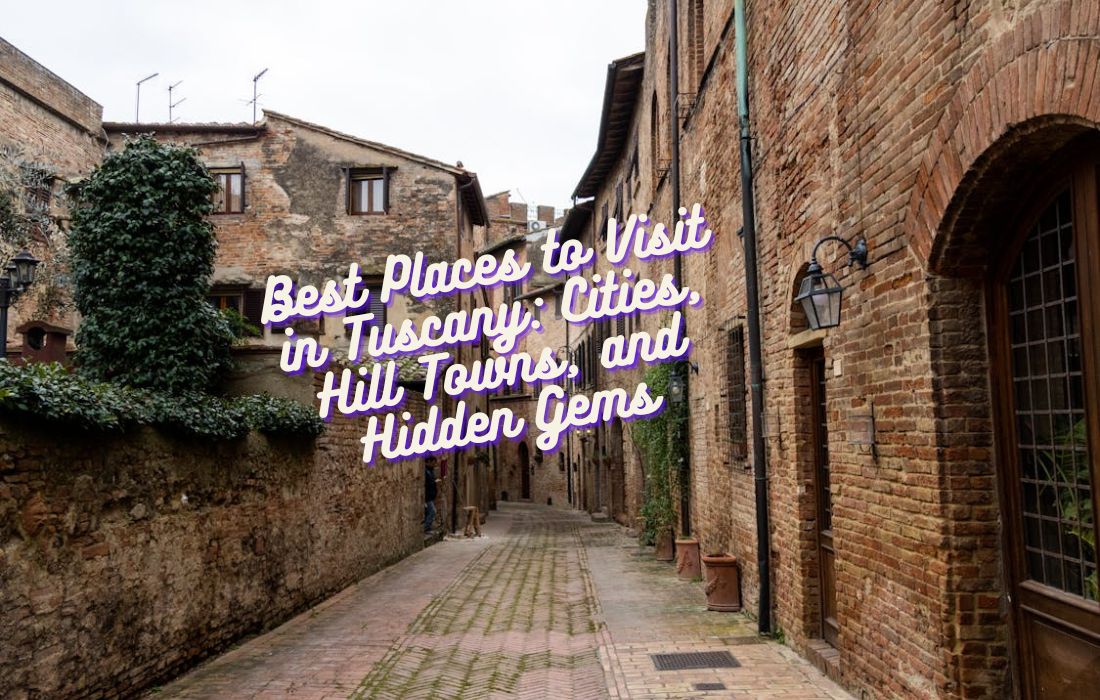
If there’s one region in Italy that feels like stepping into a painting, it’s Tuscany. Rolling vineyards stretch across golden hills, medieval towers rise above ancient stone towns, and Renaissance art fills world-famous museums. Whether you’re wandering through historic piazzas or driving along cypress-lined country roads, Tuscany offers that rare mix of culture, scenery, and slow travel magic.

It’s also one of the most cinematic destinations in Europe. Filmmakers frequently choose Tuscany’s landscapes for romantic scenes and period dramas. New productions such as Can This Love Be Translated and the upcoming romance film You, Me and Tuscany are expected to showcase the region’s dreamy countryside and timeless villages.
If you’re planning your first trip to Tuscany, here are the most beautiful places to visit, from iconic cities to hidden hilltop towns and coastal escapes.
Major Cities in Tuscany You Should Visit
Florence – The Cradle of the Renaissance
No trip to Tuscany is complete without visiting Florence, the region’s capital and one of the most culturally important cities in Europe.
Often called the “Cradle of the Renaissance,” Florence played a central role in shaping art, architecture, and philosophy in the 14th–16th centuries. Walking through its historic streets feels like visiting an open-air museum.
The city’s historic center is also recognized as a UNESCO World Heritage Site, thanks to its extraordinary concentration of Renaissance masterpieces.
Must-see highlights include:
- Florence Cathedral – famous for Brunelleschi’s massive dome
- Uffizi Gallery – home to Botticelli’s masterpieces
- Accademia Gallery
If you only have one base in Tuscany, Florence is the perfect starting point. From here, many famous Tuscan towns are reachable as day trips.

Siena – Medieval Beauty and the Palio Horse Race
South of Florence lies Siena, a remarkably preserved medieval city famous for its Gothic architecture and lively traditions.
The heart of Siena is the spectacular Piazza del Campo, a shell-shaped square widely considered one of the most beautiful piazzas in Europe.
Twice each summer, this square becomes the stage for the legendary Palio di Siena, a centuries-old horse race between the city’s neighborhoods.
Other highlights include:
- Siena Cathedral – famous for its dramatic black-and-white marble design
- medieval streets and towers
- sweeping countryside views
Like Florence, Siena’s historic center is also protected as a UNESCO World Heritage Site.
Pisa – More Than the Leaning Tower
Most travelers recognize Pisa for one reason: the famous Leaning Tower of Pisa.
The tower stands inside the breathtaking Piazza dei Miracoli, which also includes the Pisa Cathedral and Baptistery. This architectural complex is another UNESCO World Heritage Site.
But Pisa offers more than its famous landmark.
The city has a lively student atmosphere thanks to the historic University of Pisa, one of the oldest universities in Europe. Along the banks of the Arno River, colorful buildings and cozy cafés create a relaxed local vibe.

Lucca – Tuscany’s Most Charming Walled City
Often overlooked by first-time visitors, Lucca is one of the most charming cities in Tuscany.
What makes Lucca unique is its perfectly preserved Renaissance walls, built in the 16th century. Today, these massive walls form a green park that completely surrounds the historic center.
Visitors love:
- walking or cycling along the tree-lined walls
- exploring quiet medieval streets
- climbing the unusual Guinigi Tower, which has oak trees growing on its rooftop
Compared with Florence or Pisa, Lucca feels calmer and more local — perfect for slow travel.

Tuscany’s Most Beautiful Hilltop Towns
While Tuscany’s cities are fascinating, the region’s true magic often lies in its small hilltop towns.
These medieval villages rise above vineyards and olive groves, offering some of the most photogenic landscapes in Italy.
San Gimignano – The Manhattan of the Middle Ages
Few places capture Tuscany’s medieval atmosphere better than San Gimignano.
Nicknamed the “Manhattan of the Middle Ages,” the town once had more than 70 stone towers built by wealthy families competing for prestige. Today, 14 towers still remain, creating a dramatic skyline visible from miles away.
The historic center is recognized as a UNESCO World Heritage Site, and the town attracts travelers for its:
- medieval towers
- stone streets and piazzas
- sweeping countryside views
Don’t leave without trying gelato at the famous Gelateria Dondoli, often ranked among the best gelato shops in the world.

Volterra – Ancient Etruscan Heritage
Perched high above the Tuscan countryside, Volterra offers a fascinating blend of ancient civilizations.
The town was originally founded by the Etruscans, long before the Roman Empire. Remains of this ancient past can still be seen throughout the town.
Top sights include:
- Roman Theatre of Volterra
- Palazzo dei Priori
- artisan shops selling traditional alabaster sculptures
Volterra’s dramatic setting and medieval atmosphere have made it a popular backdrop for historical films and TV productions.

Monteriggioni – Tuscany’s Perfect Medieval Village
If you’ve ever imagined a perfect medieval fortress town, it probably looks like Monteriggioni.
Built in the 13th century by Siena, Monteriggioni sits on a hill surrounded by a circular ring of stone walls and watchtowers.
The village is small, but incredibly atmospheric. Visitors come here to:
- walk along the fortress walls
- explore narrow medieval streets
- enjoy views of the surrounding countryside
Because of its preserved architecture, Monteriggioni has also inspired settings in films, games, and historical series.
Pitigliano – Tuscany’s Dramatic Cliffside Town
One of Tuscany’s most visually striking villages is Pitigliano.
The town is built dramatically on cliffs of volcanic rock, making it appear as though the buildings rise directly from the stone.
Pitigliano is sometimes called “Little Jerusalem” because of its historic Jewish community.
Highlights include:
- the Jewish Quarter and synagogue
- scenic viewpoints overlooking the cliffs
- winding medieval alleys
For photographers, Pitigliano is easily one of the most unique towns in Tuscany.

Tuscany’s Famous Wine Regions
Tuscany isn’t just about historic towns — it’s also one of the world’s most famous wine regions.
Chianti – Tuscany’s Classic Wine Landscape
The area between Florence and Siena is known as Chianti, famous for its vineyards, olive groves, and charming villages.
Driving through Chianti feels like entering a postcard: rolling hills, cypress trees, and centuries-old wineries.
Popular stops include:
- Greve in Chianti
- Radda in Chianti
- Castellina in Chianti
Wine lovers can enjoy vineyard tours and tastings of the famous Chianti Classico wine.
Val d’Orcia – Tuscany’s Most Iconic Landscape
If you’ve ever seen photos of winding roads lined with cypress trees, they were probably taken in Val d’Orcia.
This breathtaking valley is recognized as a UNESCO World Heritage cultural landscape, celebrated for its harmonious Renaissance-era design of farmland, villages, and roads.
Must-visit towns include:
- Pienza – known for pecorino cheese
- Montepulciano – famous for Vino Nobile wine
- Montalcino – home of Brunello wine
Sunrise and sunset here are particularly magical.

Natural Wonders and Coastal Escapes
While Tuscany is best known for its countryside, it also offers natural hot springs and beautiful islands.
Saturnia Thermal Springs
One of the most unique experiences in Tuscany is bathing in the natural pools of Terme di Saturnia.
The cascading limestone pools known as Cascate del Mulino form turquoise waterfalls where visitors can soak in warm mineral water.
Best of all, the outdoor springs are free to visit.

Bagni San Filippo
Hidden in the forest near Val d’Orcia lies Bagni San Filippo.
These natural hot springs feature dramatic white limestone formations, including the famous “White Whale” rock formation.
The setting feels more wild and secluded than Saturnia.
Elba Island – Tuscany’s Mediterranean Escape
Just off the Tuscan coast lies Elba, the largest island in the Tuscan Archipelago.
Elba is famous for:
- crystal-clear beaches
- mountain hiking trails
- colorful seaside towns
The island is also historically significant as the place where Napoleon Bonaparte was exiled in 1814 after his first abdication.
Today, visitors can tour his former residence on the island.

Tuscany Filming Locations You Might Recognize
Thanks to its timeless scenery, Tuscany has long been a favorite filming location.
From romantic films to international TV dramas, its vineyards, medieval villages, and Renaissance cities provide the perfect cinematic backdrop.
New productions like Can This Love Be Translated and the romantic travel film You, Me and Tuscany are expected to highlight the region’s golden landscapes and charming towns.
For travelers who love visiting real-life filming locations, Tuscany offers endless opportunities to step into movie-like scenery.
Suggested Tuscany Travel Itinerary
If you’re visiting Tuscany for the first time, here’s a simple itinerary idea.
3–4 days in Tuscany
Day 1
Florence
Day 2
Siena and San Gimignano
Day 3
Chianti wine region
Day 4
Pisa or Lucca
5–7 days in Tuscany
Add:
- Val d’Orcia countryside
- Montepulciano or Montalcino
- a day trip to Elba Island or the coast
Renting a car is often the best way to explore smaller towns and countryside roads.
FAQs About Visiting Tuscany
What is the most beautiful town in Tuscany?
Many travelers consider San Gimignano, Montepulciano, and Pienza among the most beautiful towns thanks to their medieval architecture and countryside views.
How many days do you need in Tuscany?
A short trip of 3–4 days allows you to see Florence and a few nearby towns. However, spending 5–7 days is ideal for exploring wine regions and hidden villages.
What is Tuscany famous for?
Tuscany is famous for Renaissance art, historic hilltop towns, world-class wines like Chianti and Brunello, and stunning countryside landscapes.
Is Tuscany good for wine travel?
Yes. Tuscany is one of the world’s top wine regions, especially for Chianti, Brunello di Montalcino, and Vino Nobile di Montepulciano.
