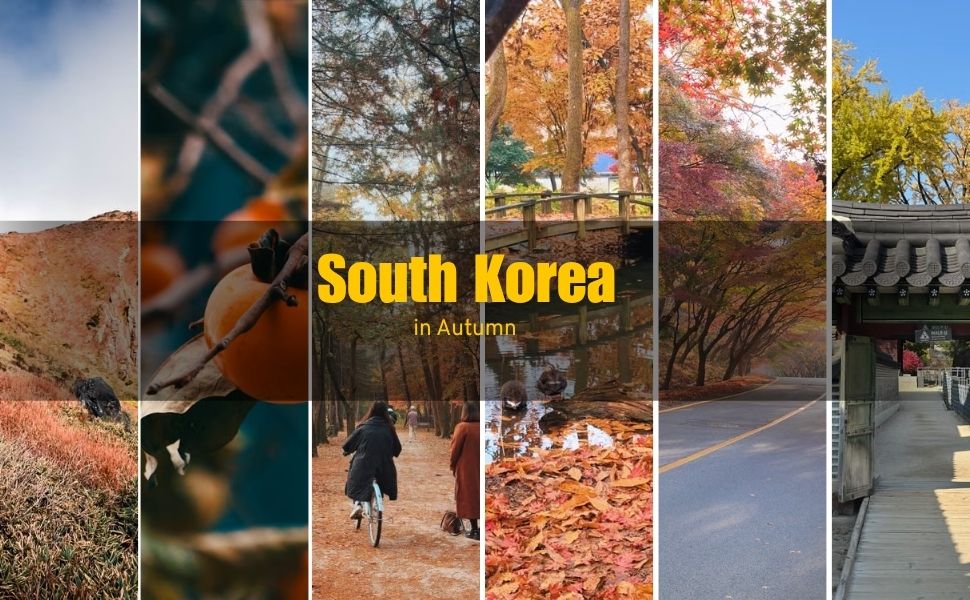
When you picture South Korea in autumn, it can feel like stepping into a K-drama: tree-lined streets glowing in red and gold, quiet mountain trails and crisp afternoons made for long walks. For around six weeks, the fall colors travel from the northern mountains down to Jeju’s coastline, giving many travelers a reason to plan their entire Korea trip around October.
South Korea in Autumn at a Glance:
- Runs roughly early September through late November, with the last week of October as the single best window to catch Seoul, Nami Island, and central Korea all near peak color at once
- Mild, dry, comfortable weather, especially in October: highs around 20°C, lows around 10°C, and less rain than spring or summer
- Foliage moves north to south and mountain to coast at roughly 1km/hour, so timing depends heavily on which region you’re chasing
- Packed with festivals: Chuseok, BIFF, lantern festivals, and palace night tours all fall in this window
- Early September still carries a small typhoon risk that fades quickly once October arrives
- Persimmons, roasted chestnuts, and warm makgeolli with pancakes show up everywhere once the weather turns

When Is Autumn in South Korea?
Korean autumn splits into three distinct moods. September opens with leftover summer humidity and the Chuseok holiday (Korea’s biggest domestic travel weekend), October is the sweet spot of clear skies and peak foliage, and November brings the first real cold snap along with the last of the color before winter sets in.
If foliage is the whole point of your trip, October is non-negotiable. If you’d rather have thinner crowds and don’t mind slightly greener trees, late September or early November both work, just with less guarantee of full color.
Weather in South Korea in Autumn
| Month | Avg low | Avg high | What to expect |
|---|---|---|---|
| September | 17°C | 26°C | Warm and still a little humid; typhoon risk is higher in the first half of the month before it tapers off |
| October | 10°C | 20°C | The clearest, driest month of the year, and peak foliage season |
| November | 3°C | 12°C | Noticeably colder, especially at night; last of the leaves, first hints of winter |
Typhoons typically affect Korea from July into early September, with the highest chance in the first half of that month, according to Climates to Travel. The risk drops sharply once October begins, which is one more reason it’s the most popular month to visit.
The 2026 Fall Foliage Forecast
Foliage moves north to south and from the mountains down to the coast at roughly 1km/hour, which is why the same “autumn in Korea” trip can look completely different depending on the week you book it. The table below blends a few Korea Forest Service-based trackers (Korea Insider, Seoul Tourism Guide), and it’s worth treating as a working estimate. The official forecast usually only firms up in early September for that year, so double-check closer to your trip.
| Region | First color | Peak color |
|---|---|---|
| Seoraksan (Gangwon-do) | late Sept | mid-to-late October |
| Nami Island / Gapyeong | mid-Oct | late Oct – early Nov |
| Seoul (Bukhansan, palaces, city parks) | mid-Oct | late Oct – mid-Nov |
| Naejangsan (Jeollabuk-do) | mid-to-late Oct | early-to-mid Nov |
| Gyeongju | mid-to-late Oct | early Nov |
| Jeju (Hallasan summit to coast) | mid-to-late Oct | late Oct – early Nov |
| Busan | late Oct | early-to-mid Nov |
The one rule worth remembering: the last week of October is when Seoul, Nami Island, and most of central Korea line up at or near peak color together. Plan a trip around that window if you only get one shot.
Seoraksan National Park turns first and turns hardest. It’s a full day trip from Seoul (or a base of a night or two in Sokcho), with cable cars and marked trails that make the peak colors accessible without a serious hike.

Nami Island, the tree-lined island made famous by K-dramas long before autumn tourism took off, is easiest as a half-day trip from Seoul and gets very crowded on weekends during peak color.

Seoul itself is one of the most convenient places to see autumn without leaving the city. Bukhansan National Park is the wildest option, but Gyeongbokgung Palace, Changdeokgung’s Secret Garden, and the Deoksugung Stonewall Walk all turn gold with maples and ginkgo trees right in the middle of downtown.

Changdeokgung’s Secret Garden runs on a timed-entry tour system, and according to Seoul Tourism Guide, tickets can sell out three to four days ahead once the leaves turn, so book earlier than you think you need to.

Naejangsan National Park, down in Jeollabuk-do, is often called Korea’s most famous fall foliage destination: a valley almost entirely canopied in deep red maples. It pairs well with a stop at Damyang’s Juknokwon bamboo forest nearby, which stays green year-round but makes an easy contrast on the same day trip.
Further south, Gyeongju turns its ancient tombs and Bulguksa Temple gold against the same backdrop that’s made it Korea’s open-air museum for over a thousand years, and Suncheon Bay Ecological Park puts on its own version of the show with silver reed fields rather than maples, best from mid-October through November.
Jeju runs on its own clock. Hallasan’s summit colors first, in mid-October, and the color works its way down to the coast by late October or early November, giving Jeju one of the longest foliage windows in the country.

Autumn Festivals & Events (September–November 2026)
Autumn is also the busiest festival stretch of the Korean calendar. Dates below are either officially confirmed or based on the historical pattern for that event, flagged accordingly since a few 2026 dates hadn’t been published yet at the time of writing.
- Chuseok holiday (confirmed): Thursday, September 24 – Saturday, September 26, 2026, with Chuseok day itself on September 25. Korea’s biggest domestic holiday, so expect packed trains, closed small shops for a few days, and a very different Seoul than usual.
- Seoul International Fireworks Festival (confirmed): held September 5, 2026 at Yeouido Hangang Park, moved earlier than its usual late-September date specifically to avoid Chuseok, according to Korea JoongAng Daily. Worth knowing about even if you’re planning a later trip, since it won’t repeat.
- Andong Mask Dance Festival (confirmed): September 25 – October 4, 2026, one of the country’s best showcases of traditional Korean performance culture.
- Jinju Namgang Yudeungje (Lantern Festival): reported for early-to-mid October 2026, with sources giving slightly different windows around October 3-19. One of Korea’s most photogenic festivals, with thousands of floating lanterns lighting up the Namgang river at the historic fortress.
- Busan International Film Festival (BIFF), 31st edition (confirmed): October 6-15, 2026, per the official BIFF site. Screenings, red-carpet events, and a citywide film-festival atmosphere across Busan.
- Gangneung Coffee Festival: reported for October 12-15, 2026, centered on Gangneung’s café culture and coastal setting.
- Gyeongbokgung Starlight Tour: reported for October 15 – November 2, 2026, an evening palace tour during peak foliage season.
- Hampyeong Grand Chrysanthemum Festival: an annual Jeollanam-do event that typically runs into late October or early November; exact 2026 dates hadn’t been published at the time of writing.
- Everland Halloween Festival: runs through the autumn season each year; the exact 2026 window hadn’t been confirmed at the time of writing.
- Seoul Lantern Festival at Cheonggyecheon: 2026 dates weren’t officially announced yet at the time of writing, but based on the past decade’s pattern, expect a window from mid-November into early December, which bridges autumn into the winter season rather than sitting squarely inside it.
What to Eat in Autumn
Korean autumn has its own food calendar. Fresh persimmons (gam) show up at every market, and dried persimmons (gotgam) become a common snack as the weather cools. Street-stall roasted chestnuts and roasted sweet potato (gungoguma) are classic cold-weather walking snacks, and rainy autumn afternoons are the traditional excuse for makgeolli paired with savory pancakes (jeon). If your trip lines up with Chuseok, look out for songpyeon, the half-moon rice cakes made specifically for the holiday.

The orange persimmons hanging on tree branches in Seoul. Image:대건 최
A 7-Day Autumn Itinerary
- Days 1-3, Seoul: palace hopping (Gyeongbokgung, Changdeokgung’s Secret Garden), the Deoksugung ginkgo walk, Bukhansan for a half-day hike, and a hanbok rental for palace photos (see where to rent hanbok in Seoul)
- Day 4, Gapyeong/Nami Island: a day trip out of Seoul for Nami Island’s tree-lined paths, timed for late October if possible
- Days 5-6, Gyeongju: KTX down to Gyeongju for Bulguksa Temple, the historic tomb parks, and Woljeonggyo Bridge lit up at night
- Day 7, Busan: wrap up on the coast, and if the dates line up, catch part of BIFF
Getting Around: KTX vs Flights
For a Seoul-to-Gyeongju-to-Busan route like the one above, the KTX high-speed rail is almost always the better call over flying: Seoul to Gyeongju (Singyeongju station) runs about 2 hours, and Seoul to Busan as fast as 2 hours 15 minutes on the quickest trains (some slower KTX services take closer to 3), per KoreanTrain and Rail Ninja. KTX also drops you in the middle of downtown rather than an airport outside the city, with no security-line buffer to plan around. Flights only make sense for Jeju, since it’s an island with no rail connection.
What to Pack
Layers are the whole strategy for a Korean autumn trip, since a 26°C September afternoon and a 3°C November night can both show up in the same week. A packable rain shell covers the tail end of typhoon season in early September, a proper jacket and scarf earn their keep by November, and comfortable walking shoes matter throughout, whether you’re on a palace’s stone paths or a mountain trail.
Travel Tips for Autumn in Korea
Book Changdeokgung’s Secret Garden tour and any Chuseok-week train tickets well in advance, since both sell out fast during peak season. Weekdays are noticeably calmer than weekends at every major foliage spot. Many travelers rely on tools like eSIM to check the foliage forecast, book last-minute festival tickets, and navigate KTX schedules on the go without hunting down a local SIM card.

Pros & Cons of Visiting South Korea in Autumn
Pros: the most comfortable weather of the year, the best light for photography, a packed festival calendar, and food that’s genuinely tied to the season.
Cons: peak-color weekends in October are crowded and some tours need advance booking, prices for flights and hotels climb around Chuseok and peak foliage weeks, and early September still carries some typhoon risk.

Final Thoughts
Autumn asks for a bit more planning than Korea’s other seasons, mostly because the color moves fast and doesn’t wait for anyone’s itinerary. Build the trip around the last week of October if foliage is the priority, or lean into September’s festivals and November’s quieter, colder final stretch if you’d rather skip the crowds.
FAQs
Is autumn a good time to visit South Korea? Yes, it’s widely considered the best season to visit: comfortable temperatures, low rainfall, clear skies, and the country’s most dramatic scenery.
When is peak fall foliage in South Korea? It varies by region. Seoraksan peaks first in mid-to-late October, while Seoul, Naejangsan, and Gyeongju typically peak from late October into mid-November. The last week of October is the best single week to catch several regions near peak at once.
What’s the weather like in South Korea in autumn? September stays warm (up to 26°C) with lingering typhoon risk early in the month, October is cool and dry (around 10-20°C), and November turns noticeably cold (3-12°C).
Does it rain a lot in Korea in autumn? No, autumn is one of the driest seasons, especially October. The main weather risk is a lingering typhoon in the first half of September rather than regular rain.
What should I wear in South Korea in autumn? Layers. Light clothing with a rain shell works for September, while a proper jacket and scarf are needed by November.
Is October or November better for foliage? October generally has the more reliable, widespread color, especially the last week of the month. November still has color in the south and on Jeju, but the north and central regions are usually past peak by then.
