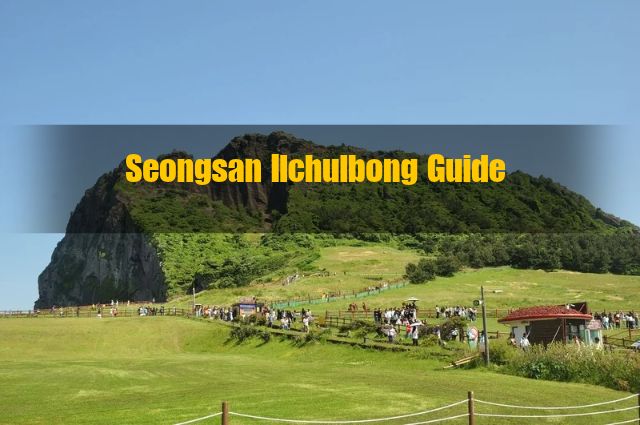
Picture a giant green crown rising straight out of the sea, with a crater so wide it looks like someone pressed a bowl into the top. That’s Seongsan Ilchulbong, Jeju’s “Sunrise Peak,” and watching the first light hit the ocean from its rim is one of those travel moments that sticks with you for years.
The good news: the climb is short, the ticket is cheap, and one of Jeju’s prettiest coastal walks, Seopjikoji, sits just across the bay. This guide covers everything in one place: opening hours by season, the entrance fee, what the hike is really like, how to time the sunrise, and how to pair it all with Seopjikoji.
Seongsan Ilchulbong at a Glance (TL;DR):
- What it is: a 182 m volcanic tuff cone on Jeju’s east tip, formed about 5,000 years ago and part of Jeju’s UNESCO World Natural Heritage site.
- Opening hours (Nov to Feb): 6:00 am to 6:00 pm, last tickets at 5:00 pm. Opens even earlier in spring, summer and autumn (see table below).
- Closed: the first Monday of every month.
- Entrance fee: ₩5,000 adults, ₩2,500 teens and children. The coastal path to the left of the ticket booth is free.
- The hike: about 25 to 30 minutes up on steep stone stairs, roughly 50 minutes to 1 hour 20 minutes round trip.
- Sunrise: around 6:50 to 7:36 am in winter. The 6:00 am opening gives you 50 to 90 minutes to climb before the sun comes up.
- Seopjikoji Coast: free coastal walk 10 minutes’ drive away, with a white lighthouse, volcanic cliffs and the best side view of Sunrise Peak. Plan 1 to 1.5 hours.
- Best for: sunrise chasers, easy hikers, photographers and anyone doing an east Jeju day.
In this guide: What is it? · Opening hours · Entrance fee · The hike · At the peak · Sunrise · What to do · Seopjikoji Coast · Seopjikoji photos · Getting there · Itinerary · FAQ

What Is Seongsan Ilchulbong?
Seongsan Ilchulbong (성산일출봉) is a tuff cone, a volcano born from an underwater eruption. When hot magma met seawater about 5,000 years ago, it exploded into fine ash that piled up around the vent, which is why the sides look so steep and layered. It started out as an island and was later joined to Jeju by a strip of sand and gravel, according to the Jeju tourism listing (in Korean).
A few quick numbers:
- Height: 182 m above sea level
- Crater: about 600 m across
- Status: part of the “Jeju Volcanic Island and Lava Tubes” UNESCO World Natural Heritage site (2007), and a Korean natural monument
The name says it all. “Seongsan” means fortress mountain (the rim of rocky spikes looks like castle walls) and “Ilchulbong” means sunrise peak. The sunrise from the top has been ranked the finest of Jeju’s ten classic scenic views for centuries.
Seongsan Ilchulbong Opening Hours (2026)
Seongsan Ilchulbong is open every day except the first Monday of the month. If that Monday is a public holiday, the closure moves to the next day. Hours change three times a year to follow the sunrise:
| Season | Opening hours | Last ticket |
|---|---|---|
| Nov to Feb (winter) | 6:00 am – 6:00 pm | 5:00 pm |
| Mar, Apr, Sep, Oct | 5:00 am – 7:00 pm | 6:00 pm |
| May to Aug (summer) | 4:30 am – 8:00 pm | 7:00 pm |
Hours via the Jeju tourism listing and Trvlogue, both checked in 2026.
- Ticket sales stop one hour before closing. In winter that means 5:00 pm, and sunset in December is around 5:30 pm, so don’t leave this one for the end of the day.
- No entry outside opening hours. You can’t climb before the gate opens, even for sunrise.
- Watch out for older blogs. Many still list 7:00 or 7:30 am opening times. The current hours open well before sunrise in every season.
New Year’s Day is different. On January 1, the summit sunrise climb runs as a special event during the Seongsan Sunrise Festival. For 2026 it was limited to 500 people who applied online in advance (first come, first served), and only confirmed applicants could enter the parking lot until 9:00 am, according to Jeju.com (in Korean). The 2027 rules haven’t been announced yet, so check the festival’s official notices in December.
Seongsan Ilchulbong Entrance Fee
| Ticket | Price |
|---|---|
| Adults (25 and over) | ₩5,000 (about US$3.50) |
| Youth (13 to 24), military | ₩2,500 |
| Children (7 to 12) | ₩2,500 |
| Ages 6 and under | Free |
| Groups of 10+ | ₩4,000 per adult |
Fees and age bands via NOL World, mom-mom and Yugacrew (checked against the Korea Tourism Organization listing in October 2026). Tickets are sold on site; no advance booking is needed.
- The fee only covers the summit trail. The plaza, the visitor center and the Umutgae coastal path (to the left of the ticket booth) are free.
- Parking at Seongsan Ilchulbong is free.
- Your ticket also gets you into the haenyeo show at Umutgae (more on that below).
- Seniors and visitors with disabilities can ask for a discount at the booth; bring ID (Travel Map Journey, in Korean).
The Seongsan Ilchulbong Hike: What to Expect
This is the part people worry about, and the honest answer is: it’s short but steep. Almost the entire way up is stone and wooden stairs, with no flat warm-up.
| Time up | About 25 to 30 minutes from the ticket booth |
| Time down | About 12 to 20 minutes |
| Round trip | 50 minutes is the official estimate; budget 1 hour 20 minutes with photos |
| Difficulty | Moderate. Steep stairs, but plenty of viewpoints to rest |
| Route | One-way loop: the up and down trails are separate |
Timings via Trvlogue and Jeju.com.
How the trail works:
- Ticket booth to the first viewpoints (10 min). Gentle stairs past strange rock pillars. Look back here for the first view of Seongsan village and the bay.
- The steep middle section (10 to 15 min). This is where everyone slows down. Rest areas with benches are spaced along the way, and every stop has a better view than the last.
- The summit deck. A wooden platform wraps around the crater rim.
- The way down. A separate trail with more wooden decking, so it’s easier on the knees. It joins the free path near Umutgae Coast at the bottom.
Tips for the hike:
- Wear proper shoes. The stairs get slippery with morning dew, and sneakers with grip are enough. Skip sandals.
- Bring water, but no food. Eating on the trail isn’t allowed.
- Use the restroom first. There are toilets near the ticket area but none at the top.
- No pets. Dogs aren’t allowed on the trail.
- Strollers won’t work. Use a baby carrier if you’re bringing a little one.
- Dress for wind. Even on a mild day, the summit is breezy. In winter the dawn wind chill can feel close to freezing.
- Take the stairs slowly on the way down. Knees feel the descent more than the climb, so cushioned shoes help (Brunch review, in Korean).
Planning more of Jeju? Our Things to Do in Jeju Island guide covers the rest of the island, east to west.

Seongsan Ilchulbong Peak: What You See at the Top
The summit deck sits right on the edge of the crater, and the first look into it surprises most people. Instead of a smoking hole, you get a huge grassy bowl about 600 m wide, ringed by about 100 jagged rock peaks. It’s like standing on the rim of a giant green stadium.
From the deck you can see:
- The crater directly in front of you (you can’t walk into it, it’s protected)
- Udo Island floating just offshore to the northeast
- Seongsan village and the long sandbar that connects the peak to Jeju
- Gwangchigi Beach and Seopjikoji curving away to the south
- On clear days, Hallasan in the distance
Take your time up here. Most people spend 15 to 20 minutes at the top before heading down.

Seongsan Ilchulbong Sunrise: How to Time It
Because Seongsan sits on Jeju’s eastern tip with open sea in front of it, it gets one of the earliest and cleanest sunrises on the island. The gates open roughly an hour or more before sunrise year round, so you can reach the top in time if you start early enough.
Approximate sunrise times at Seongsan Ilchulbong:
| Month | Sunrise (1st → 15th) | Gate opens |
|---|---|---|
| November | 6:50 → 7:03 am | 6:00 am |
| December | 7:18 → 7:28 am | 6:00 am |
| January | 7:35 → 7:36 am | 6:00 am |
| February | 7:28 → 7:17 am | 6:00 am |
| March | 7:02 → 6:44 am | 5:00 am |
| April | 6:21 → 6:03 am | 5:00 am |
| May | 5:44 → 5:32 am | 4:30 am |
| June | 5:23 → 5:21 am | 4:30 am |
| July | 5:25 → 5:32 am | 4:30 am |
| August | 5:44 → 5:54 am | 4:30 am |
| September | 6:05 → 6:14 am | 5:00 am |
| October | 6:25 → 6:35 am | 5:00 am |
Sunrise times are calculated for Seongsan Ilchulbong and line up with published local tables (for example, about 5:22 am in mid-June per Badatime and about 7:36 am on January 1 per Jeju.com). Check a weather app the night before for the exact minute.
The timing formula: be at the parking lot 40 to 45 minutes before sunrise. That gives you time to walk to the gate and climb for about 30 minutes, with a few minutes to spare. One traveler on Trvlogue arrived a little late and missed the sunrise by two minutes, so don’t cut it fine.
Winter is actually the easiest season for sunrise. From November to February the gate opens at 6:00 am and the sun doesn’t come up until 6:50 to 7:36 am, so you have a relaxed window and don’t need a 4:00 am alarm. The trade-off is the cold: bring gloves, a hat and a hot drink.
Sunrise tips:
- Stay nearby. Seongsan village has plenty of guesthouses and hotels within walking distance of the gate. Driving from Jeju City takes about an hour in the dark.
- Check the clouds, not just the forecast. Sea fog and low cloud on the horizon are common. Plenty of visitors climb and see only a glow. It’s still beautiful, but go with low expectations and you’ll be happy either way.
- Can’t face the climb? The sunrise is also lovely from the free plaza at the base, from Gwangchigi Beach and from Seopjikoji (see below).
Seongsan Ilchulbong: What to Do Besides the Hike
You can easily spend half a day around Sunrise Peak. Here’s what’s worth your time:
1. Walk the free Umutgae Coast path
To the left of the ticket booth, a free, gentle path (about 10 minutes on decking) leads down to Umutgae Coast, with the cliffs of the peak rising right above you (Jeju.com). It’s the best option if stairs aren’t for you, and the views of the volcano’s sheer side are arguably more dramatic than from the top.
2. Watch the haenyeo diving show
Jeju’s famous haenyeo (women free divers) from the Seongsan fishing cooperative perform a diving demonstration at Umutgae, usually once a day at 2:00 pm. They introduce themselves, dive for sea life, then sell and serve fresh catches like sea urchin and abalone. It’s free with your Seongsan Ilchulbong ticket, but it’s weather-dependent, so call ahead (+82-64-783-0959) if it’s a key part of your plan (Korea Tourism Organization, in Korean).
Want more haenyeo culture? See where the haenyeo scenes were filmed in When Life Gives You Tangerines: Haenyeo Bulteok.
3. Shoot the peak from Gwangchigi Beach
About a 4-minute drive south, Gwangchigi Beach gives you the classic postcard view of the whole peak across the water. Go within two hours either side of low tide, when flat volcanic rocks covered in bright green moss appear on the shore (Jeju.com). Search “성산포 물때표” (Seongsanpo tide table) to check the timing. Free entry and free parking.
[IMAGE: https://www.pexels.com/photo/scenic-view-of-seongsan-ilchulbong-on-jeju-island-29134982/ Direct: https://images.pexels.com/photos/29134982/pexels-photo-29134982.jpeg?auto=compress&cs=tinysrgb&w=1200 Filename: seongsan-ilchulbong-view-from-beach-jeju.jpg | Alt: Seongsan Ilchulbong seen across the sea from a beach on Jeju’s east coast | Caption: Photo: 현우 조 / Pexels, a beach view of Seongsan Ilchulbong, Jeju.]
4. Take the ferry to Udo Island
Seongsan Port, a few minutes from the peak, is where ferries leave for Udo Island (about 15 minutes by boat). Udo is famous for its peanut ice cream, white-sand beaches and coastal cycling. Do Seongsan Ilchulbong at sunrise, then catch a morning ferry. In winter, ferries are often cancelled or cut back on windy days (Yugacrew, in Korean), so keep Udo as a “bonus” rather than the anchor of your day.
5. Rent a hanbok for photos
Hanbok rental shops near the entrance, such as Hanbokplus, rent outfits from 2 hours to a full day, and the green peak makes a striking backdrop. They open around 10:00 am and close on Sundays (Trazy), so this works for a late-morning visit, not sunrise.
6. Warm up with a local breakfast
After a sunrise climb, the restaurants at the base serve Jeju comfort food like bomal kalguksu (sea snail noodle soup) and jeonbokjuk (abalone rice porridge).
Not sure what to order? Our Korean Food Names with Pictures guide will help.
Seopjikoji Coast: Jeju’s Most Photogenic Cape
Just across the bay from Sunrise Peak, Seopjikoji (섭지코지) is a narrow headland sticking out into the sea. The name combines the old local word for the area, “Seopji,” with “koji,” Jeju dialect for a cape. It’s free, open all day, and has the best side-on view of Seongsan Ilchulbong on the island.
Seopjikoji at a glance:
| Entrance fee | Free |
| Hours | Open 24 hours |
| Parking | Paid, up to ₩3,000 per day |
| Time needed | 1 to 1.5 hours |
| Distance from Seongsan Ilchulbong | About 10 minutes by car |
| Difficulty | Easy, mostly flat with one short climb to the lighthouse |
Details via Jeju.com and Korea Trip Tips.
What you’ll see on the Seopjikoji walk
The main loop follows the cliff edge from the parking lot to the lighthouse and back. Along the way:
- Volcanic rock formations. Dark lava rocks line the shore, including one shaped like a turtle near the start.
- Seondolbawi (Seondol Rock). A tall, lone sea stack standing just off the cliffs, one of the most photographed rocks on the cape.
- The old beacon tower (yeondae). A stone signal station built from volcanic rock, about 4 m high and 9 m across, once used to send smoke and fire signals along the coast (Korea Trip Tips).
- Bangdupo Lighthouse. The white octagonal lighthouse on top of Bulgeun Oreum, a red volcanic hill. Locals call it the “Wish Lighthouse.” You can’t climb the tower itself, but a stair path takes you up the hill for a panorama that takes in Seongsan Ilchulbong and the whole coast (Korea by Bike).
- Grazing horses and canola fields. Horses often graze on the grass, and in March to April the slopes turn yellow with canola flowers.
- Tadao Ando architecture. The Glass House is now the Floist bakery café, with a front-row view of Sunrise Peak (Sports Kyunghyang, in Korean). Nearby, the Yumin Art Museum is also an Ando design.
K-drama connection: Seopjikoji was a filming spot for the classic drama All In (2003), and it has appeared in many Korean films and dramas since.
Seopjikoji tips:
- It’s very windy. Bring a windproof jacket, even in summer.
- Combine it with sunrise. Seopjikoji faces Sunrise Peak, so if you skip the summit climb, it makes a peaceful sunrise spot. The Yumin Art Museum (9:00 am) and Glass House (10:00 am) open later, though.
- Aqua Planet Jeju, a large aquarium, sits at the entrance to the cape if you’re traveling with kids.
Seeing Jeju in spring? Time your Seopjikoji walk with the canola bloom, and check our Jeju Canola Flower Festival guide.
Seopjikoji Photos: The Best Spots
Seopjikoji is one of the most photographed places on Jeju. These are the shots worth lining up:
- The lighthouse from the beacon hill. The classic frame: white lighthouse on the red hill, with yellow canola (March to April) or green grass in front.
- Sunrise Peak across the water. From the cliff path, Seongsan Ilchulbong sits on the horizon. Best in the soft morning light.
- Seondolbawi at sunset. The sea stack turns gold in late afternoon.
- From the lighthouse railing. Looking back down the whole cape, with the ocean on both sides.
- Glass House windows. Sunrise Peak framed by Ando’s glass, coffee in hand.
How to Get to Seongsan Ilchulbong and Seopjikoji
By car (easiest). Seongsan Ilchulbong is about an hour’s drive east of Jeju Airport. Parking at the peak is free; Seopjikoji’s lot charges up to ₩3,000. A rental car is by far the easiest way to do sunrise.
By bus from Jeju Airport. Take express bus 101 (airport → Jocheon → Gimnyeong → Seongsan → Namwon), which runs along the east coast and is the simplest single route to Seongsan. Express fares start at ₩2,000 by card and max out at ₩3,000 (Jeju.com, in Korean). Check the exact stop for the peak and Seopjikoji in Kakao Map or Naver Map before you set off, since Google Maps doesn’t give reliable transit directions in Korea.
Between Seongsan Ilchulbong and Seopjikoji. A taxi takes about 10 minutes. There’s also the Ilchulbong GO, an 8-seat self-driving shuttle. Since August 1, 2026 it runs a new route between Phoenix Island (Seopjikoji) and the Seongsan Port entrance along the main road, and charges the same fare as a regular city bus (Financial News, in Korean). In November and December only one vehicle runs, 6 times a day, so check the timetable before relying on it (Seoul Shinmun, in Korean).
For sunrise without a car: stay in Seongsan village and walk, or pre-book a taxi the night before. Buses don’t run early enough.
Stay connected: bus apps, tide tables and taxi apps all need data, so set up a Korea eSIM before you land.
Sample Half-Day Itinerary (Winter)
| Time | Plan |
|---|---|
| 6:00 am | Gate opens. Start climbing by about 6:20 am |
| 6:50 to 7:35 am | Sunrise from the summit (depends on the month) |
| 8:00 am | Walk down, then breakfast in Seongsan village |
| 9:00 am | Gwangchigi Beach (if low tide falls later, swap this with Seopjikoji) |
| 10:00 am | Seopjikoji walk to the lighthouse, coffee at the Glass House |
| 12:00 pm | Lunch, then Udo ferry or head on to the rest of east Jeju |
| 2:00 pm | Optional: back to Umutgae for the haenyeo show |
FAQ
What are Seongsan Ilchulbong’s opening hours?
From November to February it’s open 6:00 am to 6:00 pm. March, April, September and October: 5:00 am to 7:00 pm. May to August: 4:30 am to 8:00 pm. Ticket sales close one hour before closing, and it’s closed on the first Monday of each month.
How much is the Seongsan Ilchulbong entrance fee?
₩5,000 for adults and ₩2,500 for teens and children. Young children enter free. The fee covers the summit trail; the Umutgae coastal path and the base area are free.
How long does the Seongsan Ilchulbong hike take?
About 25 to 30 minutes up and 15 to 20 minutes down. Plan around 1 hour 20 minutes round trip if you stop for photos at the viewpoints and the summit.
Is the Seongsan Ilchulbong hike hard?
It’s short but steep, with stairs almost all the way. Anyone with average fitness can do it at an easy pace, using the rest stops along the way. Older kids manage it fine.
Can you see the sunrise from Seongsan Ilchulbong every day?
Yes. The gate opens before sunrise every day except the first Monday of the month, so you can climb up in time. January 1 is the exception: the summit sunrise climb is limited to pre-registered festival participants.
What time should I arrive for sunrise at Seongsan Ilchulbong?
Arrive at the parking lot 40 to 45 minutes before sunrise. In winter, sunrise is between about 6:50 and 7:36 am, so aim to be there by around 6:10 to 6:50 am.
Is Seopjikoji free?
Yes, Seopjikoji is free and open 24 hours. Only the parking lot charges a fee, up to ₩3,000 a day.
How far is Seopjikoji from Seongsan Ilchulbong?
About 10 minutes by car or taxi. You can also take the Ilchulbong GO shuttle between Phoenix Island and the Seongsan Port roundabout.
Can you do Seongsan Ilchulbong and Seopjikoji in one day?
Easily. They’re right next to each other, so half a day covers both, with time left for Gwangchigi Beach or Udo Island.
Is Seongsan Ilchulbong worth it?
Yes. It’s cheap, quick, and the crater view from the top is unlike anything else in Korea. If stairs are a problem, the free Umutgae path and Gwangchigi Beach still give you great views of the peak.
Related Reading
- Things to Do in Jeju Island, South Korea
- 10 Most Beautiful Places in Jeju Island (Including K-Drama Filming Locations)
- Where Is the Haenyeo Bulteok from When Life Gives You Tangerines?
- Best Time to Visit the Green Barley Fields from When Life Gives You Tangerines
- Jeju Canola Flower Festival
- Korean Food Names with Pictures
- South Korea Travel Guide
- K-Drama Filming Locations

