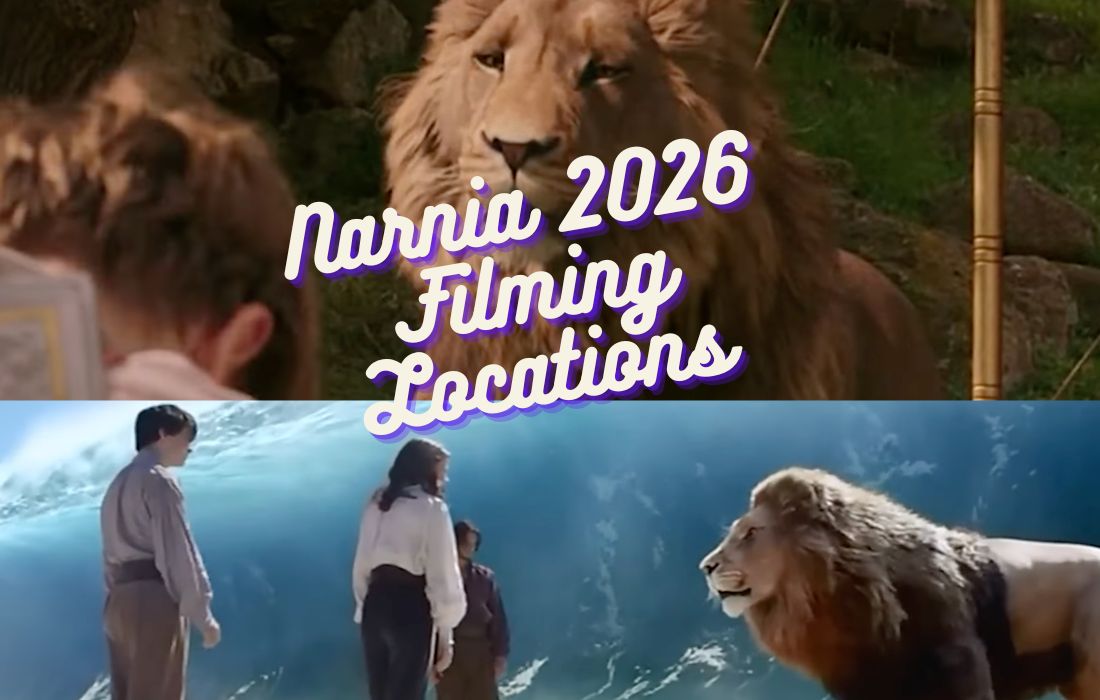
There’s a certain kind of storytelling that doesn’t begin in fantasy, but in places that feel unmistakably real. That’s exactly the approach Greta Gerwig brings to her adaptation of The Magician’s Nephew. Instead of relying purely on CGI, Narnia (2026) was filmed across carefully chosen locations in England, where historic streets, quiet churches, and industrial corners quietly shape the narrative.
Principal photography ran from August 2025 to January 2026, with a mix of on-location filming in London and Northern England alongside large-scale studio production. This layered approach reflects the story itself, moving from the ordinary world into something far more magical.
TL;DR
- Primary filming locations: London, Manchester, Bradford, UK studios
- Key sites: Old Royal Naval College, St Bartholomew the Great, Castlefield
- Studios: Shepperton Studios, Cardington Studios
- Filming style: Real-world settings first, fantasy worlds later
- Travel insight: Many filming locations double as hidden gems you can actually visit
About Narnia (2026): Plot, Cast & Release Date
Before diving deeper into the filming locations, it helps to understand what Narnia (2026) is actually about. Directed by Greta Gerwig, the film adapts The Magician’s Nephew, serving as an origin story for the world of Narnia. The plot follows two children, Digory and Polly, who discover magical rings that allow them to travel between worlds. Along the way, they accidentally awaken the powerful and dangerous Jadis and witness the creation of Narnia by Aslan.
The cast features a mix of established stars and newcomers, including Emma Mackey as Jadis and Daniel Craig in a key supporting role, with additional performances from Carey Mulligan. Some reports also suggest Meryl Streep may voice Aslan, though this has not been officially confirmed.
As for the release, Narnia (2026) is expected to debut with a limited IMAX theatrical run in November 2026 before arriving globally on Netflix on December 25, 2026.
London Filming Locations in Narnia (2026)
To understand where Narnia (2026) was filmed, it helps to start in London. This is where the story is grounded before it opens into other worlds.
Royal Exchange and Bank Area
Before the magic begins, the film establishes its version of 1950s London in the financial district around the Royal Exchange.
This area likely represents:
- The everyday world of Digory and Polly
- The setting for early disruption caused by Jadis
Because of its neoclassical architecture and dense layout, the location naturally supports large-scale street scenes without heavy visual effects. As a result, it becomes one of the most important real-world anchors in the film.
Travel angle: If you visit early in the morning, the quiet streets and stone facades make it easy to imagine the city transformed into a cinematic set.
Old Royal Naval College, Greenwich
Moving slightly away from central London, filming also took place at the Old Royal Naval College.

This location often appears in period films, and here it likely serves as:
- A heightened version of London
- A space where reality begins to feel stylized
Its symmetry and open courtyards create a sense of scale that subtly prepares the audience for the transition into fantasy.
Travel insight: Pair a visit here with a walk along the Thames at sunset. The shifting light adds to the almost theatrical atmosphere.

St Bartholomew the Great
As the film moves closer to its magical elements, more atmospheric locations come into play. One of the most intriguing is St Bartholomew the Great.
This historic church may represent:
- A gateway-like space between worlds
- Or a visual inspiration for more mystical environments
Its dim interiors and ancient stonework create a timeless feeling that aligns closely with the themes of The Magician’s Nephew.
Hidden gem: Despite its cinematic appeal, this location remains relatively under-visited compared to other London landmarks.
River Thames
Finally, scenes filmed along the River Thames introduce a more symbolic layer to the story.

These sequences likely function as:
- Transitional moments between realities
- Visual metaphors for crossing into unknown worlds
At low tide, the exposed riverbanks offer textures that feel almost otherworldly, making them ideal for scenes that blur the line between real and imagined.
Northern England Filming Locations
While London provides the foundation, the production expands north to deepen the film’s visual and emotional range. These locations add contrast and texture to the story.

Castlefield, Manchester
One of the most notable filming locations outside London is Castlefield.
This area likely represents:
- A more industrial version of London
- Working-class environments that ground the narrative
With its canals, brick warehouses, and iron bridges, Castlefield introduces a slightly harsher visual tone. Consequently, it reinforces the idea that the story begins in a complex, imperfect world.
Travel tip: Walk along the canals in the early evening for a quieter, more atmospheric experience.

Victoria Baths
Another Manchester location used during filming is Victoria Baths.
Although exact scenes are unconfirmed, this space may serve as:
- A surreal interior environment
- A setting connected to Uncle Andrew and his experiments
The building’s ornate tiles and large halls create a visually striking environment that can easily be transformed into something fantastical.
Hidden gem: Often called a “water palace,” this site is one of the most unique interiors in the UK.
Bradford and Little Germany
Filming also extended to Little Germany, known for its narrow streets and historic architecture.
This location likely functions as:
- Dense urban streets for chase sequences
- A continuation of the film’s 1950s setting
Because of its preserved architecture, it requires minimal modification to match the film’s time period.
Studio Filming Locations in Narnia (2026)
After establishing the real world, the production transitions into fully controlled environments. This is where the fantasy elements of Narnia truly take shape.
Shepperton Studios
At the center of the production is Shepperton Studios, which served as the main filming hub.
Here, filmmakers could build:
- Interior sets
- Controlled lighting environments
- Early fantasy sequences
This allowed for consistency as the story gradually shifts away from reality.
Cardington Studios
In contrast, Cardington Studios offers a much larger scale.
This space is most likely used for:
- The creation of Narnia
- Expansive, mythic scenes involving Aslan
Because of its massive hangar structure, it is ideal for scenes that require both physical sets and visual effects working together.
Longcross Studios
Finally, Longcross Studios supports additional filming needs.
It likely houses:
- Dialogue-driven scenes
- Interior environments that connect different parts of the story
Together, these studios form the backbone of the film’s fantasy world.
How Filming Locations Reflect the Story
Now that the key filming locations are clear, it becomes easier to see how they connect to the narrative structure.
Real World (London and Northern England)
The film begins in grounded, recognizable environments. This makes the characters and their journey feel relatable.
Transitional Spaces (Churches and Riverbanks)
As the story progresses, the locations become quieter and more symbolic. These spaces hint that something is about to change.
Fantasy Worlds (Studio Sets)
Finally, the story fully enters Narnia. At this stage, the environments become larger, more stylized, and more abstract.
This progression mirrors the structure of The Magician’s Nephew, where the journey into fantasy unfolds gradually rather than all at once.
Hidden Travel Guide: Visit the Real Narnia Filming Locations
If you’re inspired to explore where Narnia (2026) was filmed, you can easily turn these locations into a travel itinerary.
Day 1: Central London
Start at the Royal Exchange, then walk toward the Thames. End your day at St Bartholomew the Great.
Day 2: Greenwich
Visit the Old Royal Naval College and explore the surrounding area for a more open, cinematic setting.
Day 3: Manchester
Head to Castlefield and Victoria Baths to experience a different side of England’s urban landscape.
Day 4: Optional Studio Areas
While studios like Shepperton are not open to the public, visiting nearby areas gives you a sense of the scale behind the production.
FAQs About Narnia (2026) Filming Locations
Where was Narnia (2026) filmed?
Narnia (2026) was filmed primarily in England, with key locations in London, Manchester, and Bradford. Major scenes were also shot in studios like Shepperton Studios and Cardington Studios, where large-scale fantasy sets were built.
Was Narnia (2026) filmed in London?
Yes, a significant portion of the film was shot in London. Locations such as the Royal Exchange, Old Royal Naval College, and St Bartholomew the Great were used to recreate a stylized 1950s setting.
Can you visit the Narnia filming locations?
Most of the real-world filming locations are open to the public. You can walk through central London, explore Greenwich, or visit areas like Castlefield. However, studios such as Shepperton Studios are not generally open for public tours.
Was Narnia (2026) filmed entirely in studios?
No, the film combines real locations with studio production. While fantasy worlds were created in controlled environments, many early scenes were filmed on location to create a more grounded and realistic tone.
When was Narnia (2026) filmed?
Filming took place between August 2025 and January 2026, across multiple locations in the UK.
When will Narnia (2026) be released?
The film is expected to have a limited IMAX theatrical release in November 2026, followed by a global streaming release on Netflix on December 25, 2026.
What book is Narnia (2026) based on?
The film is based on The Magician’s Nephew, which serves as a prequel in The Chronicles of Narnia series and explores the origin of the magical world.
Final Thoughts
So, where was Narnia (2026) filmed? The answer goes beyond a simple list of locations.
By combining real places with carefully designed studio environments, Greta Gerwig creates a journey that feels grounded before it becomes magical. Each location plays a role, not just as a backdrop, but as part of the story’s emotional progression.
For travelers, this means something even more interesting. You don’t need to step into a fantasy world to experience Narnia. In many ways, the journey begins in places you can visit right now.
Sources & References
To ensure accuracy and credibility, this article is based on verified production reports, filming updates, and industry coverage:
- Greta Gerwig’s Narnia Officially Wraps Filming
- Greta Gerwig’s Narnia Begins Filming in the UK for Netflix
- Where Is Narnia Filmed? Full UK Locations Guide
- Netflix’s Narnia: What We Know So Far
- First Look at Netflix’s Narnia Set in London
- Narnia Filming Begins in Central London (Photos)
Latest posts
