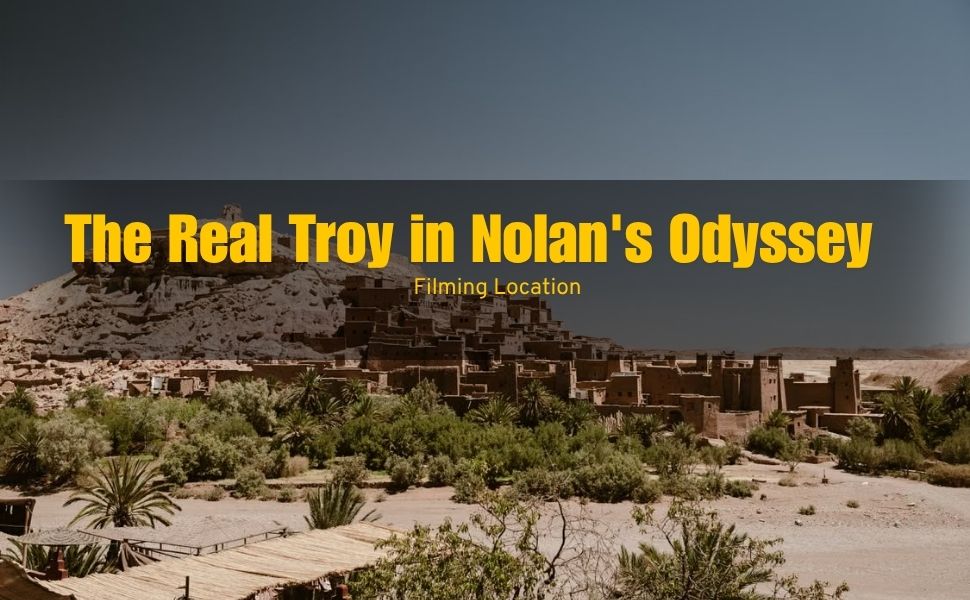
When Christopher Nolan needed a city that could pass for ancient Troy at the end of the Trojan War, he did not build one on a soundstage. He took his IMAX cameras to a 900-year-old village of packed earth in southern Morocco. That village is Aït Benhaddou, and it opens The Odyssey (2026) with one of the most recognizable skylines in world cinema.
If Nolan’s epic has you dreaming of the Mediterranean, this is one of the few stops on its map you can walk through today, no ferry or permit required. Here is the film connection, the real history of the ksar, and exactly how to visit.
Want the full picture first? See our main guide: The Odyssey (2026) Filming Locations: All Six Countries.
Quick Facts
- Where: Aït Benhaddou (Aït Ben Haddou), near Ouarzazate, southern Morocco
- In the film: stands in for the city of Troy in the opening Trojan War sequence
- Filmed: late February 2025, one of the production’s first shoots
- Status: UNESCO World Heritage Site since 1987
- Entry fee: none. It is a living village, open all day
- From Marrakech: about 180 km, roughly 3.5 hours over the Tizi n’Tichka Pass
Aït Benhaddou in The Odyssey
Filming on The Odyssey began in late February 2025 at Aït Benhaddou, making Morocco one of the first legs of a shoot that ran until August 2025 and crossed multiple countries. The village’s earthen towers and hillside of stacked houses stood in for Troy in the film’s opening, set at the close of the Trojan War before Odysseus begins his long journey home.
There is a nice piece of history here. Nolan has spoken about circling a Trojan War epic early in his career, more than twenty years before Batman Begins set him on a different path. Whether or not that project would ever have happened, he has now put the fall of Troy on IMAX film, and he did it against the ramparts of Aït Benhaddou.

The choice fits Nolan’s whole approach on this film. He wanted the “physicality of the real world,” shooting on location rather than in front of green screens so the landscapes could shape the story. Few places carry that ancient-world weight as naturally as a ksar that has stood since the caravan era.
A Village That Has Played Half of Cinema History
Aït Benhaddou is often called the most filmed location in Africa, and it has appeared in more than 80 productions. Nolan is joining a very long guest list.
The open ground beside the ksar is where Ridley Scott staged the exterior arena scenes of Gladiator (2000), with those earthen towers visible in the background. In Game of Thrones, the village became Yunkai, one of the slaver cities Daenerys liberates across Essos in seasons 3 and 4. It has also doubled for the ancient world in Lawrence of Arabia, The Mummy, Prince of Persia, and Kingdom of Heaven, among many others.
Once you have seen it, you start recognizing it everywhere. That familiarity is part of why it reads so instantly as “an ancient city” on screen, which is exactly what Nolan needed for Troy.
The Real History of the Ksar
Long before the film crews, Aït Benhaddou was a working stop on the caravan route between the Sahara and Marrakech. A ksar is a fortified village, and this one is built almost entirely from pisé, a mix of raw clay, straw, and stone packed into thick walls that climb the hillside above the Ounila valley.
The site has been fortified since around the 11th century, during the Almoravid period, though most of the buildings you see today date from the 17th century onward. It earned UNESCO World Heritage status in 1987 for being one of the best surviving examples of southern Morocco’s earthen architecture. A handful of Berber families still live inside the old walls and maintain the traditional houses.

How to Visit Aït Benhaddou
Getting there. Most travelers come from Marrakech, about 180 km away. The drive takes roughly 3.5 hours and crosses the Tizi n’Tichka Pass, one of Morocco’s most scenic mountain roads, winding through Berber villages in the High Atlas. If you would rather not rush, Ouarzazate sits just 30 km east and makes an easy base. From there a taxi to the ksar runs about 150 to 200 dirham.
Entry and hours. There is no entrance fee. Aït Benhaddou is a living village rather than a ticketed monument, so it stays open all day. You cross a small river (there are stepping stones and a footbridge) to reach the old ksar on the far bank. Some resident families charge a small tip to show you inside their homes, which is well worth it to see the interiors and rooftops.
What to do once you are there. Wander the narrow earthen lanes, step into a traditional house, and climb to the old granary at the top for a panoramic view over the valley and palm groves. It is a compact site, so an hour or two covers it comfortably.
Best time to go. Arrive early morning or late afternoon. Tour buses tend to roll in around midday, and the low sun makes the clay walls glow, which is when the ksar looks most like it belongs in a film.
Pair it with. Ouarzazate is nicknamed “Ouallywood” for its film studios and is worth a stop, and the restored Telouet Kasbah sits along the old Tizi n’Tichka road. Many people do Aït Benhaddou as part of a longer route toward the Sahara dunes.
A One-Day Aït Benhaddou Trip from Marrakech
Most travelers see Aït Benhaddou as a day trip from Marrakech. Here is a simple way to plan it so you arrive when the light is good and the tour buses are not.
- Early morning (7 to 8 am): Leave Marrakech and drive up over the Tizi n’Tichka Pass. Build in a stop or two for photos, the mountain views are half the reason to go by road.
- Late morning (around 11 am): Arrive at Aït Benhaddou. Cross the river to the old ksar, wander the earthen lanes, step into a traditional house, and climb to the granary at the top for the panoramic valley view.
- Early afternoon: Drive 30 km to Ouarzazate, nicknamed “Ouallywood,” and visit the Atlas Film Studios or the restored Taourirt Kasbah.
- Late afternoon: Head back toward Marrakech, or push on if you are continuing south.
Total driving is around 7 hours round trip, so an early start matters. Going with a driver or small-group tour saves the hassle of the mountain road.
Prefer to slow down? Stay overnight in Ouarzazate and see the ksar twice, at sunset and again at sunrise, when it is nearly empty. This also sets you up perfectly if you are carrying on to the Sahara dunes at Merzouga or Zagora.
Is It Worth the Trip?
If you are the kind of traveler who plans holidays around film locations, Aït Benhaddou is close to a perfect one. It is genuinely ancient, free to enter, endlessly photogenic, and layered with cinema history from Gladiator to Game of Thrones and now Nolan’s Odyssey. Standing where the film’s Troy rises out of the desert is about as close as you can get to stepping into the movie.
Continue the journey: The Odyssey: Real Places Behind the Myth maps where Ithaca, Ogygia, and the rest of Homer’s world really sit.
FAQs
Was The Odyssey (2026) filmed in Morocco?
Yes. Christopher Nolan’s The Odyssey began filming in late February 2025 at Aït Benhaddou near Ouarzazate, Morocco. The production also shot around Marrakech and Essaouira before moving on to Greece, Italy, Iceland, Scotland, and Western Sahara.
What location plays Troy in The Odyssey?
Aït Benhaddou, the UNESCO-listed ksar in southern Morocco, stands in for the city of Troy in the film’s opening sequence at the end of the Trojan War.
Can you visit Aït Benhaddou?
Yes. It is a living village with no entrance fee, open all day. It sits about 180 km from Marrakech (roughly 3.5 hours over the Tizi n’Tichka Pass) and 30 km from Ouarzazate.
What other movies were filmed at Aït Benhaddou?
Aït Benhaddou is the most filmed location in Africa, with more than 80 productions to its name, including Gladiator, Game of Thrones (as Yunkai), Lawrence of Arabia, The Mummy, Prince of Persia, and Kingdom of Heaven.
How long do you need at Aït Benhaddou?
One to two hours is enough to walk the lanes, visit a traditional house, and climb to the granary for the view. Many travelers combine it with Ouarzazate or a trip toward the Sahara.
Related reading
